EB-5 Eligibility Explained
The United States continues to be a land of promise for international investors, where dreams and investments meet to build lasting success. The EB-5 Immigrant Investor Program offers a straightforward path to realizing these goals, offering a copyright through investment for those who are able to contribute a meaningful economic impact to the U.S. economy. This is not simply an investment but a process-one that requires careful planning, considerable financial resources, and comprehensive knowledge of a complex legal framework. This guide functions as your comprehensive resource, a strategic roadmap for navigating the intricacies of the EB-5 program. We will examine the critical financial thresholds, the strategic importance of investment location, the comprehensive application process, and the final benefits of this exceptional opportunity. For those just beginning to explore your options or are ready to take the next step, this article will provide the knowledge and understanding you need to advance decisively toward your American dream.
Important Insights
- The EB-5 program provides a clear route to getting a U.S. copyright for qualified investors, their married partners, and unmarried children under 21 through a significant investment in the U.S. economy.
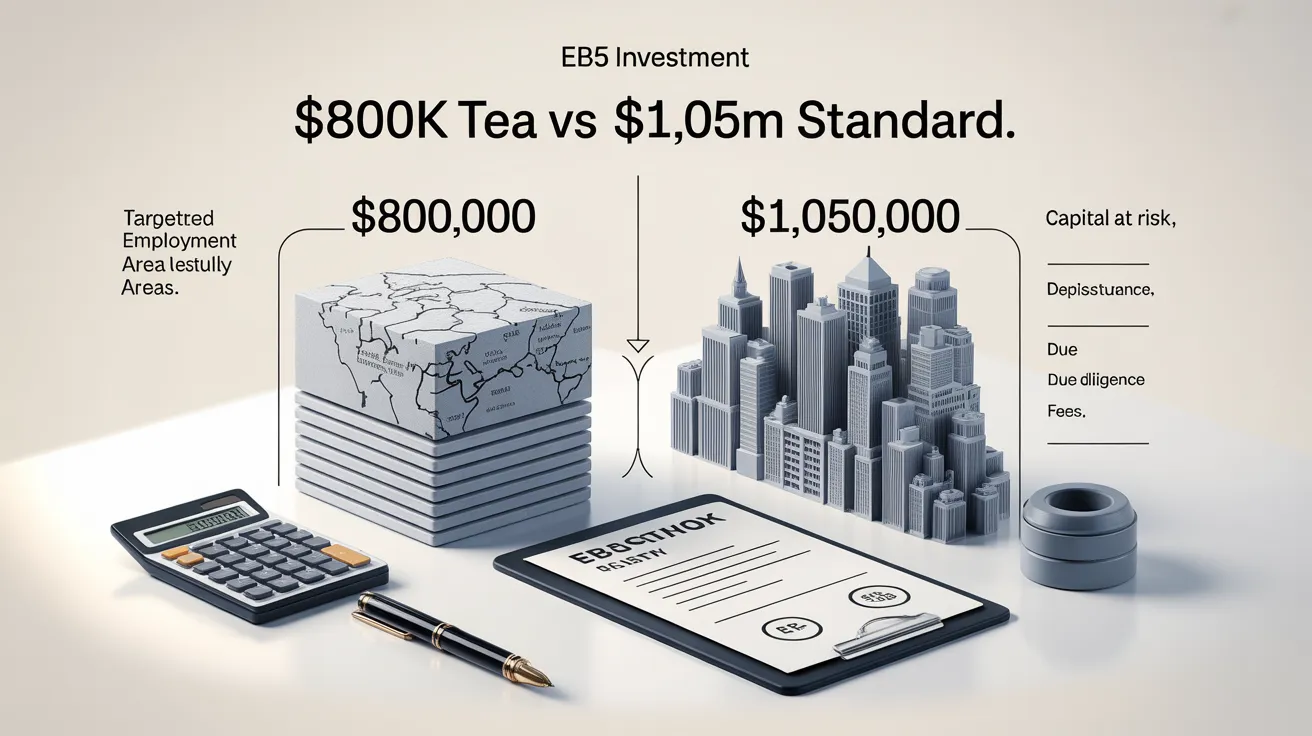
- The regular EB-5 investment amount comes to $1,050,000, but this is reduced to $800,000 for projects located in a Targeted Employment Area (TEA) or qualifying infrastructure projects.
- The Targeted Employment Area TEA refers to a geographic region that's rural or experiencing high unemployment, and investing in one is a key strategy for qualifying with a lower capital outlay.
- Meeting the fundamental EB-5 visa requirements is absolutely essential; this involves demonstrating the lawful source of funds, placing the funds "at risk," and generating no fewer than 10 permanent American jobs.
- The final stage arrives in securing a permanent copyright through investment after a two-year conditional residency period, which necessitates submitting a final application (Form I-829) to demonstrate compliance.
- Working with a knowledgeable EB-5 lawyer is vital and indispensable for navigating the program's complexities, from initial due diligence to final visa approval.
Decoding the Financials: A Deep Dive into the EB-5 Investment Amount
The monetary investment stands as the key element of the EB-5 program, and a comprehensive grasp of the required EB-5 investment amount is the foundational first step for every potential investor. The program is designed to encourage capital placement in particular regions of the U.S. economy, and consequently, the required investment amount varies depending on the geographic location of the investment project. This is not just a transactional fee but a considerable financial investment into a new commercial enterprise that must generate economic activity and employment. The investment has to be fully "at risk," meaning it faces both potential gains and losses, without any guarantees of return. This essential component emphasizes the entrepreneurial nature of the program and distinguishes it from a simple visa purchase. USCIS adjudicators will thoroughly assess the project's business plan and financial structure to confirm the capital is legitimately at risk of loss and not a passive, guaranteed loan.
The $800,000 or $1,050,000 Decision
USCIS has established a dual-level investment structure to direct capital into areas requiring economic growth. The reduced investment requirement of $800,000 is available for projects situated within a Targeted Employment Area (TEA). For ventures beyond these designated areas, the investment requirement increases to $1,050,000. This significant $250,000 difference in capital commitment makes the placement of your investment a vital strategic decision that can significantly influence your EB-5 process. It is also imperative for investors to consider additional costs in addition to the main investment. These include USCIS filing fees, legal fees for your immigration counsel, and administrative fees assessed by Regional Centers. These supplementary costs can be substantial and need to be factored into your financial strategy from the beginning to ensure a smooth and predictable process avoiding unexpected financial challenges.
Strategic Geography: Understanding the Power of a Targeted Employment Area (TEA)
The designation of a Targeted Employment Area TEA is central to the EB-5 program's economic development goals and represents a significant strategic advantage for strategic investors. A TEA is classified by USCIS as one of a designated rural area or a area with an unemployment rate of at least 150% of the national average. By establishing a lower investment threshold for projects in these areas, the program seeks to boost economic development and create jobs where they are needed most. For the investor, a TEA-based project offers not only a considerably lower capital requirement but also other potential advantages. Under the EB-5 Reform and Integrity Act of 2022, visa set-asides were established for TEA projects, which can facilitate faster processing times for investors from backlogged countries. The classification of a TEA is a statistics-based procedure based on official statistics, and investors must work with their legal team to confirm their chosen project maintains eligibility at the time of filing their petition, as these designations can change over time.
Your Path to Success: Navigating the Key EB-5 Visa Requirements
In addition to the financial investment, the EB-5 program maintains essential criteria that all investors must satisfy to obtain a copyright. These EB-5 visa requirements are designed to ensure that the investment has a authentic, quantifiable, and positive impact on the U.S. economy. To begin with, the investment must create at least 10 full-time, permanent jobs for qualifying U.S. workers. The approach for tracking these jobs distinguishes between direct investments (which only count direct W-2 employees) and Regional Center projects (which can also count indirect and induced jobs). Additionally, as noted earlier, the investment funds must be totally committed and "at risk" in a new commercial enterprise, exposed to both gain and loss. Lastly, the investor must provide comprehensive, reliable documentation to prove that the investment capital was sourced through lawful means. This "source of funds" requirement is among the most challenging elements of the entire process, demanding a clear paper trail for every dollar invested.
Exploring the Two Options for Residency: Direct Investment vs. Regional Centers
The EB-5 investment program features two distinct investment models: the Regional Center program and the direct investment option. A Regional Center is a USCIS-approved institution that administers investment projects and aggregates capital from multiple EB-5 investors. This is a more passive investment option, as the Regional Center handles the day-to-day administration of the project and the complex task of tracking job creation. This structure is frequently selected by investors who do not wish to be engaged in running a U.S. business. In contrast, a direct investment is a more hands-on approach where the investor directly participates in the operation of the business they invest in. This pathway offers increased involvement and hands-on management but also demands substantially more operational responsibility and a thorough understanding of the U.S. business environment. The decision between these two paths is determined by the investor's risk tolerance, level of involvement, and overall investment philosophy.
The Road to Achievement: Completing Your I-526E Petition
The formal EB-5 process starts with the submission of Form I-526E, Petition for Alien Entrepreneur. This application functions as the official investor submission to USCIS and must be accompanied by an extensive collection of documents that demonstrate compliance with all program requirements. This is not a simple form but a detailed legal and financial submission that acts as the foundation for the entire immigration process. It contains the project's comprehensive business plan, proof of investment transaction, and detailed financial source documentation. The thoroughness, accuracy, and quality of this petition are essential for positive results, as any inconsistencies or gaps may result in significant delays or possible rejection.
The Critical Role of Source of Funds Documentation
The source of funds documentation is arguably the most time-consuming and examined component of the I-526E petition. The applicant must develop a transparent, systematic, and continuous documentation path that follows the investment capital from its origin to the EB-5 project. This requires furnishing multiple years of tax documentation, bank statements, evidence of income from salary or business ownership, records of real estate or asset sales, and legal documents for any gifts or loans used. The comprehensiveness and openness of this paperwork are crucial to a successful petition outcome. USCIS scrutinizes this documentation meticulously to avoid fraud, money laundering, and to maintain the overall integrity of the program.
Understanding the Timeline: Visa Bulletins and Priority Dates Explained
As a result of annual per-country visa limits, applicants from nations with significant EB-5 application volumes, particularly China and India, could encounter a substantial waiting period termed a visa backlog. The Visa Bulletin, released monthly by the U.S. Department of State, delivers details about visa availability. When an investor submits their I-526E petition, they are allocated a Priority Date. They must then wait until their priority date becomes marked as "current" on the Visa Bulletin before they can proceed with the final steps of acquiring their copyright. This waiting period can be a source of significant anxiety for applicants and their loved ones, but with proper planning and professional support from an immigration attorney, it can be navigated successfully. Being aware of the visa set-asides for TEA projects can also be a key strategy in potentially shortening this wait.
From Conditional to Permanent: Securing Your copyright Through Investment
After acceptance of the I-526E petition and when a visa is available, the investor and their eligible dependents are issued a two-year Conditional copyright. This permits them to live, work, and study in the U.S. as lawful residents. However, the "conditional" status indicates the journey is not yet concluded. To secure a permanent copyright through investment, the investor must file Form I-829 within the 90-day timeframe before the conditional copyright expires. This petition acts as the final proof, proving that the investment was sustained throughout the two-year period and that the required 10 jobs were established and sustained. Upon the approval of the I-829, the conditions are removed, and the investor and their family become lawful permanent residents of the United States, the last and most significant step in the EB-5 process.
Navigating EB-5: The Importance of Skilled Legal Counsel
The EB-5 program is a complex and constantly evolving area of U.S. immigration law, with nuances that can be difficult for even the most knowledgeable investor. Managing the intricate requirements, from initial project assessment to the ultimate condition removal, requires a thorough and up-to-date understanding of the legal landscape. An experienced EB-5 lawyer serves as your legal guide, offering essential support at every phase of the application. They will help you conduct due diligence on potential projects and Regional Centers, thoroughly document and document your source of funds, develop the detailed legal documentation that supports your application, and speak on your behalf before USCIS. The right legal counsel can determine a successful outcome and a problematic, prolonged denial. An EB-5 lawyer is not merely a legal representative but a key strategic advisor in your immigration process.
EB-5 Investment: A Legacy of Lasting Returns and Benefits
Although the EB-5 program requires a significant upfront investment and a multi-year commitment, the ultimate return on that investment is immeasurable. This is an opportunity for a new beginning, abundant in opportunity and independence. The benefits extend far beyond any monetary gains. A U.S. copyright grants the freedom to live, work, and study throughout America, creating endless opportunities for the investor and their family. Children gain access to top-tier universities at in-state tuition costs. After maintaining copyright status for five years, the investor and their family might be able to pursue U.S. citizenship, completing their journey to joining American society as full members. This is the ultimate ROI-an inheritance of freedom, security, and opportunity for generations to come.
Frequently Asked Questions
Which funding sources are permitted for EB-5 investments
USCIS requires a comprehensive and detailed documentation of the source of all investment funds to verify they were legally acquired. Acceptable sources include salary savings, investment earnings (such as stocks or real estate), corporate ownership distributions, revenue from real estate transactions, funds from selling a business, and monetary gifts from others. When funds are received as a gift, comprehensive proof of the donor's legitimate fund source must be provided. Investment funding through loans is possible, though assets owned by the investor must collateralize the loan, and the investor must bear personal liability for the debt.
How long does the EB-5 process take?
The length of the EB-5 journey differs substantially depending on several factors, including the applicant's nationality, the unique aspects of their situation, and processing durations at USCIS. The first I-526E petition can take anywhere from several months to more than two years for USCIS to process. After approval, investors from oversubscribed countries (such as China and India) could experience delays of multiple years for their visa number to become available on the Visa Bulletin. The entire process, from beginning investment to receiving a permanent copyright, generally spans between three and ten years or longer.
What occurs when an I-829 petition gets denied?
When an I-829 petition to remove conditions gets rejected, the applicant's conditional copyright status is terminated, and they might be placed in deportation proceedings. Nevertheless, this is not always the end of the process. Options exist to contest the decision through the Administrative Appeals Office (AAO) or to lodge a motion to reopen or reconsider the case with USCIS. In some cases, it might be feasible to provide new documentation or legal positions. It is essential to work with an experienced EB-5 lawyer immediately upon obtaining a notice of intent to deny or a denial to manage this complicated process and examine all possible legal options.
Is travel outside the U.S. permitted with a Conditional copyright?
That's correct, as a conditional copyright, you can travel outside the U.S. with your conditional copyright, which serves as a valid re-entry document. However, it is essential to maintain your residency in the U.S. and not to undertake any trips that could be interpreted by immigration authorities as an abandonment of your U.S. residency. Long periods away from the U.S., typically for more than six months to a year, could create a presumption that you green card through investment have given up your residence and could put at risk your ability to re-enter the country and to remove the conditions on your copyright.
How do direct and indirect job creation differ
Employment generation is the core foundation of the EB-5 program. Direct jobs consist of roles created directly by the new commercial enterprise in which the investor has invested. These are identifiable, W-2 employees employed by the enterprise. Indirect employment includes positions established indirectly due to the investment but not within the new commercial enterprise, including jobs generated in suppliers supporting the project. Induced jobs are those generated when the EB-5 project employees investing their earnings in the community. Regional Center investments can count direct, indirect, and induced jobs (calculated using approved economic models), providing an easier path to meet the 10-job requirement. Direct investments must rely solely on direct jobs.